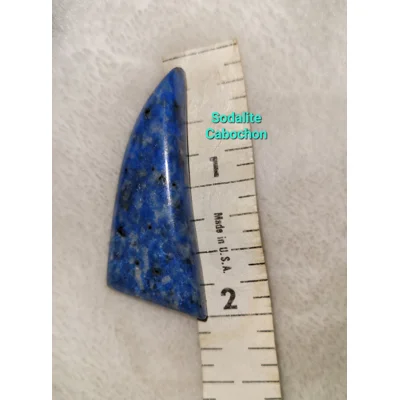


Sodalite Cabochon
Sodalite is often mistaken for lapis lazuli due to its rich blue color, but it lacks the brassy pyrite inclusions found in lapis.A sodalite cabochon is a polished deep blue gemstone often veined with white, prized for symbolizing mental clarity, truth, and rational thought. Known as the "Thinker's Stone" or "Poet's Stone," it is used in jewelry, carvings, and polished pieces while promoting calmness, emotional balance, and enhanced communication. For a stone of frequent mistaken identity, Sodalite is unimaginatively named for its sodium content. The more poetic "poor man's lapis" is a common nickname for this beautiful blue-and-white mineral. Sodalite and lapis lazuli can be easily mistaken for each other at first glance; however, lapis contains flecks of pyrite, which is where the stones differ. To complicate matters, lapis lazuli (which is technically a rock) may sometimes contain sodalite (which is a mineral in itself). Sodalite is sometimes also confused with azurite, dumortierite and lazulite. Additionally, in Canada, sodalite can be referred to as "Princess Blue" because it was found in Ontario in 1891 during the visit of two members of the British Royal Family. Sodalite is sometimes considered a guardian for heroes and heroines, especially those speaking truth to power. It's believed to have the ability to unite logic with intuition and the drive for truth with the rise of idealism. Practitioners have used sodalite to organize the mind, as it's said to promote rational thought, objectivity and perception. It is sometimes thought to cleanse lymph nodes and boost the immune system. All these balancing abilities are why sodalite is often used in groups with other stones and among multiple users. Sodalite is assigned to the western astrological sign Sagittarius. In feng shui, it is thought to possess water energy. While blue (with white inclusions) is the most common color of sodalite, this stone can also be found in grey, green, yellow, light red and lavender varieties. (The purple variety of sodalite is called Hackmanite.) Sodalite properties include fluorescing orange under ultraviolet light, except for Hackmanite. That variant displays tenebrescence instead, becoming deeper and richer in color after UV exposure (although the effect fades after time).